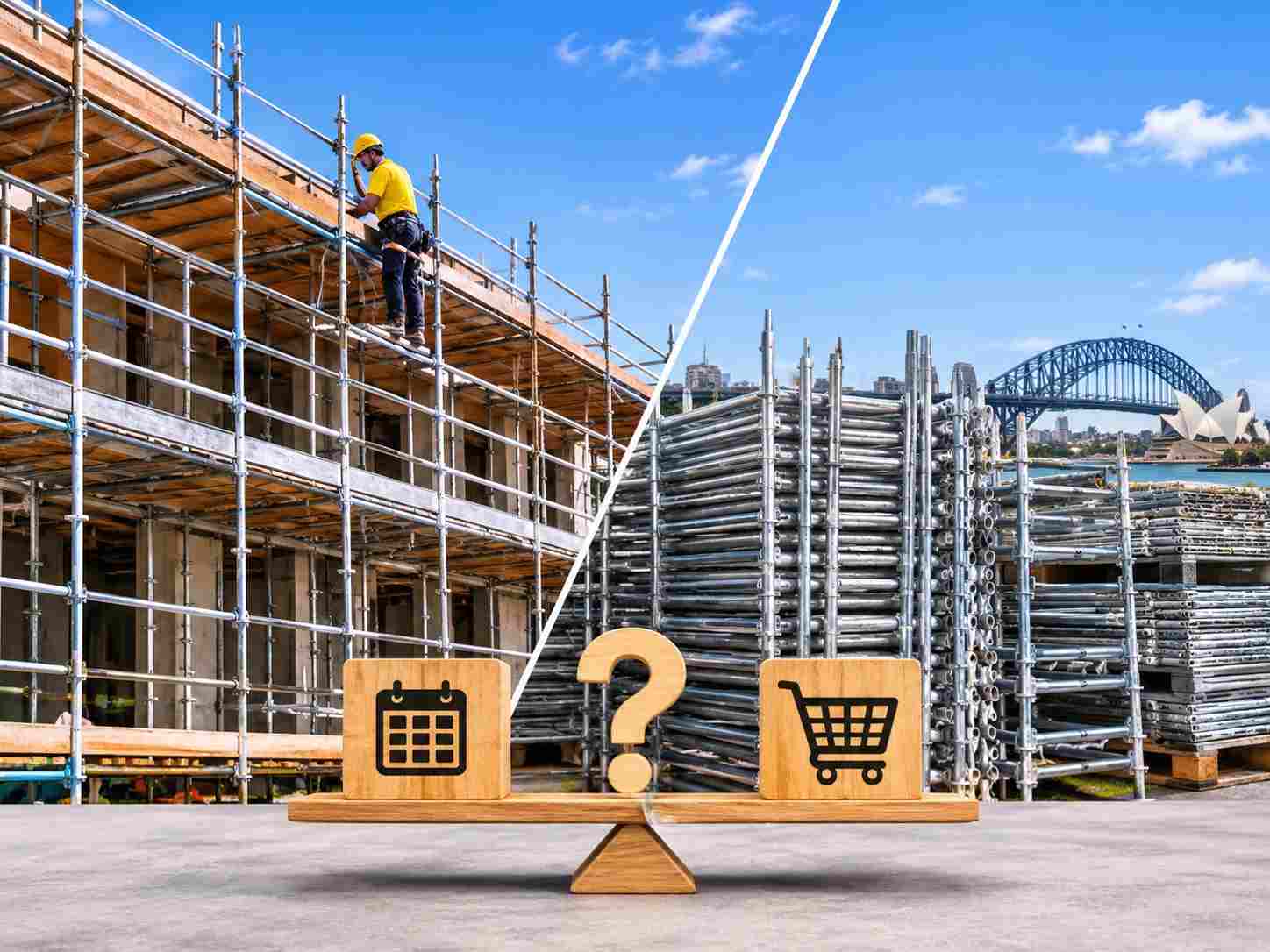
Every builder hits this question: do we hire scaffold for this job, or buy our own?
There’s no single right answer. It comes down to how often you use it, how long each job runs, and whether you have the crew and storage to look after it. This guide gives you a straight way to decide.
The Short Answer
- Hire if scaffold is an occasional need, jobs are short, or the setup is complex.
- Buy if you use scaffold constantly, run long jobs, and have licensed people and space to store it.
- Mix both if your workload swings. Own a core set and hire extra for peak jobs.
Hire vs Buy at a Glance
Hire | Buy | |
Upfront cost | Low | High |
Cost over time | Rises with every week | Fixed, then spread across jobs |
Maintenance | Supplier’s job | Your job |
Storage | Not needed | Needed |
Flexibility | High, change size per job | Limited to what you own |
Compliance | Supplier supplies compliant gear | You must keep it compliant |
Best for | Short, occasional or complex jobs | Frequent, long-running work |
Resale value | None | Can recover part of the cost |
When Hiring Makes Sense
- One-off or occasional jobs: you’d pay for a full set that sits in the yard
- Short jobs: a few weeks of hire beats a large capital outlay
- Complex or engineered scaffold: designed and erected by the hire company
- Unusual access needs: shape, height or loads you don’t normally handle
- Tight cash flow: hire protects working capital
- No storage space: no yard, no problem
- No licensed scaffolders on the crew: hire often includes erection and dismantle
When Buying Makes Sense
- You use scaffold on most jobs: the set pays for itself through reuse
- Long projects: weekly hire charges add up fast on jobs running months
- You have licensed scaffolders: you can erect, inspect and hand over legally
- You have dry storage: components last longer
- You want control: no waiting on availability or delivery slots
- You can resell later: well-kept modular scaffold holds value
Work Out the Real Cost: The Break-Even Method
Don’t guess. Run the numbers.
Step 1: Get your purchase cost
Total price of the set you’d need, including accessories and delivery.
Step 2: Add ownership costs
- Storage
- Repairs and replacement parts
- Inspections
- Transport between sites
- Training and licences
- Insurance
Step 3: Get your hire cost
Weekly hire rate for the same set, plus delivery, collection and erect/dismantle if charged.
Step 4: Divide
Break-even (weeks) = Total purchase and ownership cost ÷ Weekly hire cost
Example (illustrative numbers only, not real quotes)
- Purchase and ownership cost: $10,000
- Weekly hire cost for the same set: $500
- Break-even: 10,000 ÷ 500 = 20 weeks
If you’ll use the scaffold for more than 20 weeks in total, buying starts to win. If you’ll use it for less, hire wins. Swap in your own real quotes to get your answer.
Hidden Costs People Forget
On the hire side:
- Delivery and pick-up fees
- Erection and dismantling charges
- Extra weeks if the job runs over
- Damage or loss charges
- Minimum hire periods
On the buy side:
- Storage space and racking
- Repairs and replacement parts
- Regular inspections and record keeping
- Licensed labour to erect and dismantle
- Depreciation
- Transport between sites
A fair comparison counts both lists.
Compliance: Who Carries the Responsibility?
Scaffolding in NSW is regulated whether you hire or buy.
- Components should comply with AS/NZS 1576 and AS/NZS 1577
- Erecting scaffold where a person could fall more than 4 metres requires a high-risk work licence
- Scaffolds over 4 metres need a handover certificate before use
- Scaffolds must be inspected regularly and after storms, impacts or alterations
- Edge protection should meet AS 4994
With hire, the supplier usually provides compliant gear and may include licensed erection.
With purchase, all of this becomes your responsibility.
Check current requirements on the SafeWork NSW website, as rules get updated.
Decision Guide: Which One Are You?
You’re probably a hire customer if:
- You use scaffold fewer than a few times a year
- Jobs are short
- You don’t have licensed scaffolders
- You don’t have storage
- You prefer predictable, job-by-job costs
You’re probably a buyer if:
- Scaffold is on most of your jobs
- You have licensed people in-house
- You have a yard and racking
- You run long projects
- You’ve already spent more on hire than a set would cost
You’re probably a mix if:
- Your workload is seasonal or uneven
- You own enough for typical jobs and hire extras for peaks
5 Questions to Ask Before You Decide
- How many weeks per year will I realistically use scaffold?
- What would the same set cost to hire over that time?
- Do I have licensed people to erect and inspect it?
- Do I have somewhere dry to store it?
- Can I afford the upfront cost without hurting cash flow?
If you answer “yes” to the last four and the first two numbers favour buying, buy.
Common Mistakes
- Buying too early. A set that sits idle costs money.
- Hiring forever. Years of rolling hire on a long job can cost more than the equipment.
- Ignoring licensing. Owning scaffold doesn’t mean your crew can legally erect it.
- Under-sizing the purchase. Buying a set too small means hiring extra anyway.
- Skipping the maths. Gut feel is usually wrong on this one.
Delivery and Logistics in Sydney
Hire or buy, scaffold is heavy and awkward to move.
- Confirm truck access, especially in tight inner-city streets
- Check council or permit requirements for street deliveries
- Arrange unloading (Hiab or forklift)
- Make sure someone is on site to receive and sort it
Frequently Asked Questions – Scaffolding Hire vs Buying in Sydney
Hiring scaffolding is generally more cost-effective for short-term or occasional projects. Buying can offer better long-term value for contractors who regularly use scaffolding across multiple construction projects.
Compare the total purchase and ownership costs with the weekly scaffolding hire rate. If you expect to use the equipment beyond the break-even period, purchasing may be the more economical option.
Scaffolding hire inclusions vary between suppliers. Some provide equipment only, while others offer additional erection and dismantling services. Always confirm the scope and costs before booking.
In NSW, a high-risk work licence is required for scaffolding work where a person or object could fall more than 4 metres. The appropriate licence class depends on the work being performed. Check SafeWork NSW requirements before starting.
Scaffolding suppliers must provide equipment that meets applicable requirements. However, contractors and site managers also have workplace safety responsibilities, including ensuring proper use, inspections and preventing unauthorised modifications.
Yes. Well-maintained scaffolding systems, including Kwikstage scaffolding, can retain resale value. Keeping equipment in good condition and maintaining compatible components can help support future resale.
Yes. Many builders and contractors purchase their essential scaffolding equipment and hire additional components when larger projects require extra access or working platforms.
Get a Scaffolding Quote in Sydney
Looking for affordable scaffolding hire or scaffolding for sale in Sydney? Contact Building Gear with your project requirements and our team can help you find the right solution.
📧 sales@buildinggear.com.au