Order the wrong reinforcing mesh and you won’t find out until well after the pour — when a slab starts cracking under load it was never designed for, or an inspector flags that the mesh doesn’t match the engineering spec. Reinforcing mesh looks simple from the outside: a grid of welded steel wire. But which grid, which wire gauge, and which pattern you use changes depending on what the concrete actually needs to do.
This guide breaks down the three main types of reinforcing mesh used in Australian construction, how their sizing works, and which one fits which application — so you’re ordering the right product the first time.
What Is Concrete Reinforcing Mesh?
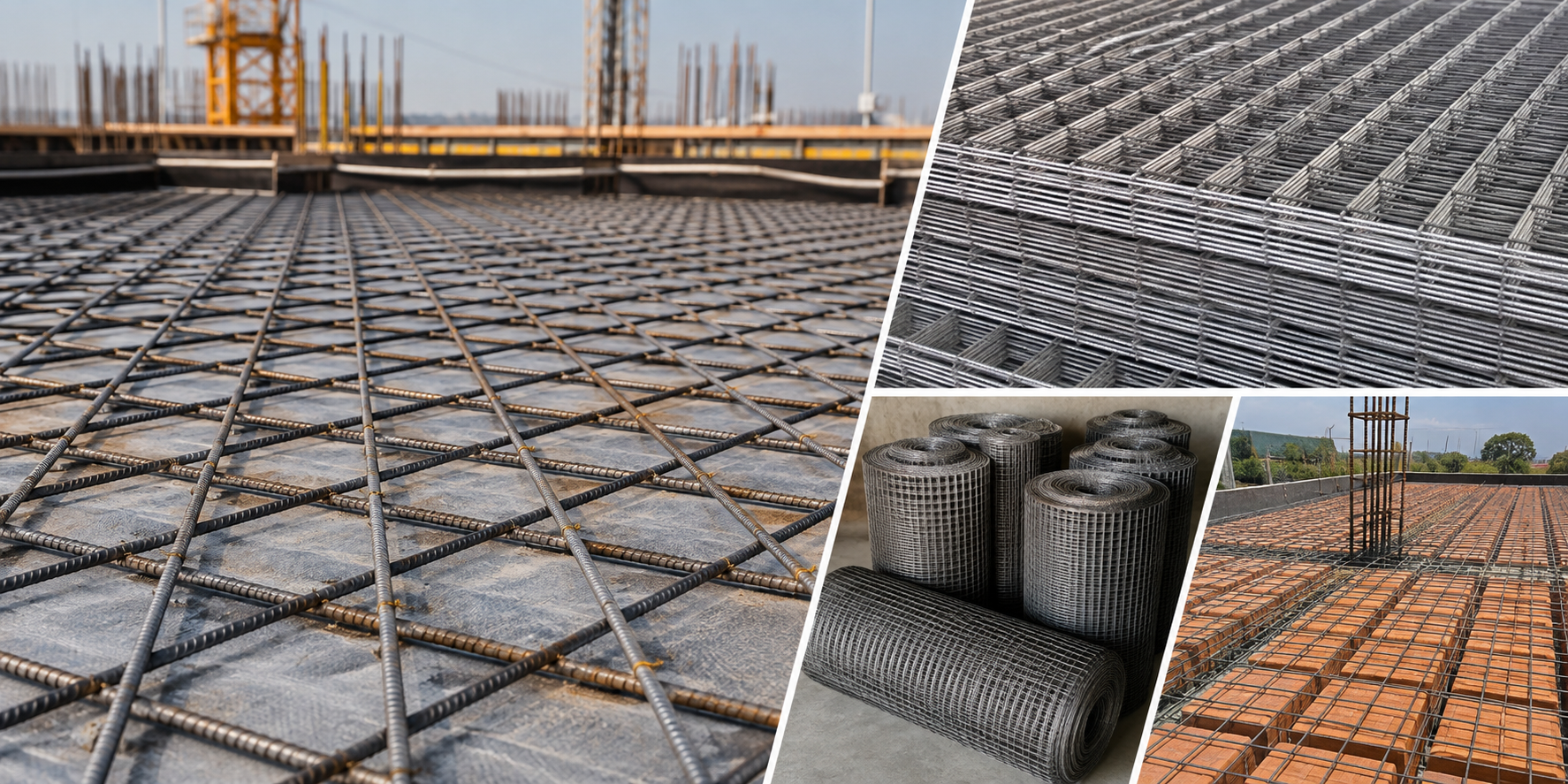
Concrete reinforcing mesh — often called “reo mesh” — is a grid of steel wires welded together at each intersection, laid inside concrete before it’s poured. Concrete is strong under compression but weak under tension; the mesh gives it the tensile strength it can’t provide on its own, controlling cracking and helping the slab or structural element carry load as intended.
In Australia, reinforcing mesh is manufactured to AS/NZS 4671, the standard governing steel reinforcing materials for concrete. Mesh that’s ACRS-certified has been independently verified against this standard — worth checking for on structural applications, not just slabs you’re pouring for yourself.
The Three Main Types of Reinforcing Mesh
SL Mesh (Square Mesh)
SL mesh has equal wire spacing in both directions, forming a square grid. It’s the most commonly used mesh type in residential and light commercial construction, because the square pattern distributes load evenly in all directions — which suits most ground-bearing slabs where load isn’t concentrated in one direction.
Typical uses: house slabs, driveways, garage floors, pathways, general concrete pavements, and precast panels.
You’ll see SL mesh sold in a series — SL52, SL62, SL72, SL82, SL92, SL102 and similar — with the number reflecting a heavier wire gauge as it increases. Heavier-gauge mesh generally suits applications carrying more load or requiring greater crack control; lighter gauges suit lighter domestic slabs. Because exact wire diameter, spacing and weight vary slightly by manufacturer, always check the current spec sheet for the specific SL grade you’re ordering — or confirm it against your engineer’s specification — rather than assuming figures from one supplier apply universally.
RL Mesh (Rectangular Mesh)
RL mesh uses a rectangular grid — the longitudinal wires are more closely spaced and typically heavier than the cross wires, giving the mesh greater strength in one direction rather than evenly in both.
Typical uses: suspended slabs, structural elements in commercial and multi-storey construction, and any application where load runs predominantly in one direction rather than being evenly distributed.
RL mesh is common in the RL800-series and similar designations, and — like SL mesh — is specified based on the structural engineering requirements of the project, not just picked off the shelf.
Trench Mesh
Trench mesh is a narrow-width mesh — commonly available from around 200mm up to 400mm or wider, depending on the supplier — purpose-built for footings and strip foundations rather than flat slabs. It has closely spaced longitudinal bars running the length of the trench, giving continuous reinforcement along a footing’s length.
Typical uses: residential footings, strip foundations, and other trench-style structural elements below a slab.
Trench mesh is usually specified using a code combining bar size and bar count — for example, a designation might indicate N12 or N16 bar diameter with 3 or 4 longitudinal bars (“3TM” or “4TM”). The correct combination depends entirely on your engineer’s footing design; this isn’t a product to substitute on assumption.
How Reinforcing Mesh Sizing Actually Works
Reinforcing mesh sizing communicates two things: the wire diameter/grade (heavier wire = more strength) and the pattern (square vs. rectangular vs. trench). A few practical points that help when reading a mesh spec or quote:
Standard sheet size for SL and RL mesh is commonly 6m x 2.4m (with actual usable/effective coverage often slightly less once overlap is accounted for) — though this can vary by manufacturer, so confirm sheet dimensions when calculating quantities.
Older “F” designations (like F62, F72, F82) are still used by some suppliers alongside the current SL numbering (SL62, SL72, SL82) — in practice they typically refer to the equivalent product, but it’s worth confirming with your supplier that an “F” reference and an “SL” reference on a quote mean the same thing before you order.
Overlap (“lapping”) between sheets is required at joins to maintain structural continuity — this affects how many sheets you actually need to cover a given slab area, not just a straight area-to-sheet-size calculation.
Bar chairs, which hold the mesh at the correct height within the pour, are calculated per sheet and are easy to under-order if they’re not included in the original quote.
Which Mesh Type Suits Your Project?
Application | Typical Mesh Type | Why |
House slab, garage floor, driveway | SL Mesh | Even load distribution in all directions |
Footpath or linear concrete path | RL Mesh | Directional strength where load runs lengthwise |
Suspended slab, multi-storey structural element | RL Mesh | Heavier, direction-specific reinforcement |
Residential footing or strip foundation | Trench Mesh | Continuous reinforcement along a narrow trench |
Precast panels | SL Mesh | Uniform strength for handling and installed loads |
This table is a general guide, not a substitute for an engineer’s specification — particularly for anything structural, suspended, or outside standard residential slab work.
Common Mistakes When Ordering Reinforcing Mesh
- Assuming SL and RL are interchangeable. They’re engineered for different load patterns — using square mesh where rectangular was specified (or vice versa) isn’t a like-for-like substitution.
- Under-ordering for lapping. Calculating quantity purely on slab area without allowing for overlap between sheets leads to running short mid-pour.
- Forgetting bar chairs. Mesh sitting on the ground rather than held at the correct height within the pour won’t perform as designed.
- Mixing up “F” and “SL” references without confirming equivalence with the supplier, particularly when comparing quotes from different manufacturers.
- Substituting mesh grade without engineering sign-off, even when a heavier or lighter gauge seems like a reasonable-sounding swap.
Getting the Right Mesh for Your Project
If your project has a structural engineer’s specification, the mesh type, grade and quantity should already be defined — the job is sourcing exactly what’s specified, confirmed against AS/NZS 4671 and ACRS certification where required. For general slab work without a formal spec, matching mesh type to application (using the table above as a starting point) and confirming sheet size, lapping allowance and bar chair quantity with your supplier before ordering will avoid the most common on-site surprises.
Building Gear assists builders, contractors and developers across Sydney with sourcing building materials for a range of construction projects. If you’re finalising materials for an upcoming pour and want a hand confirming quantities or specifications, send through your plans or requirements and we’ll assist where we can.
📧 sales@buildinggear.com.au 📞 0494 393 682 🌐 www.buildinggear.com.au
Neither option is “better” — it depends on whether you already have trusted installers lined up, or whether you’d rather one supplier manage more of the process.
Frequently Asked Questions
What's the difference between SL and RL mesh?
SL (square) mesh has equal wire spacing in both directions and suits general slabs where load is evenly distributed. RL (rectangular) mesh has heavier, more closely spaced wires in one direction, suited to structural or suspended applications where load runs predominantly one way.
What is trench mesh used for?
Trench mesh is a narrow mesh designed specifically for footings and strip foundations, providing continuous reinforcement along the length of a trench rather than across a flat slab.
Does reinforcing mesh need to be certified?
For structural applications, mesh should be ACRS-certified and compliant with AS/NZS 4671 to confirm it meets the required strength and quality standards.
Are "F" mesh and "SL" mesh the same thing?
They often refer to equivalent products under different naming conventions, but this should be confirmed directly with your supplier before ordering, since not all suppliers use the two designations identically.