If you’re pouring slabs, beams or columns in Sydney, your formwork materials decide how clean the finish is, how fast the crew works, and whether the pour goes to plan.
This guide covers what to buy, what to check, and how to avoid the mistakes that cost builders time and money.
What You Need for a Typical Slab or Beam Pour
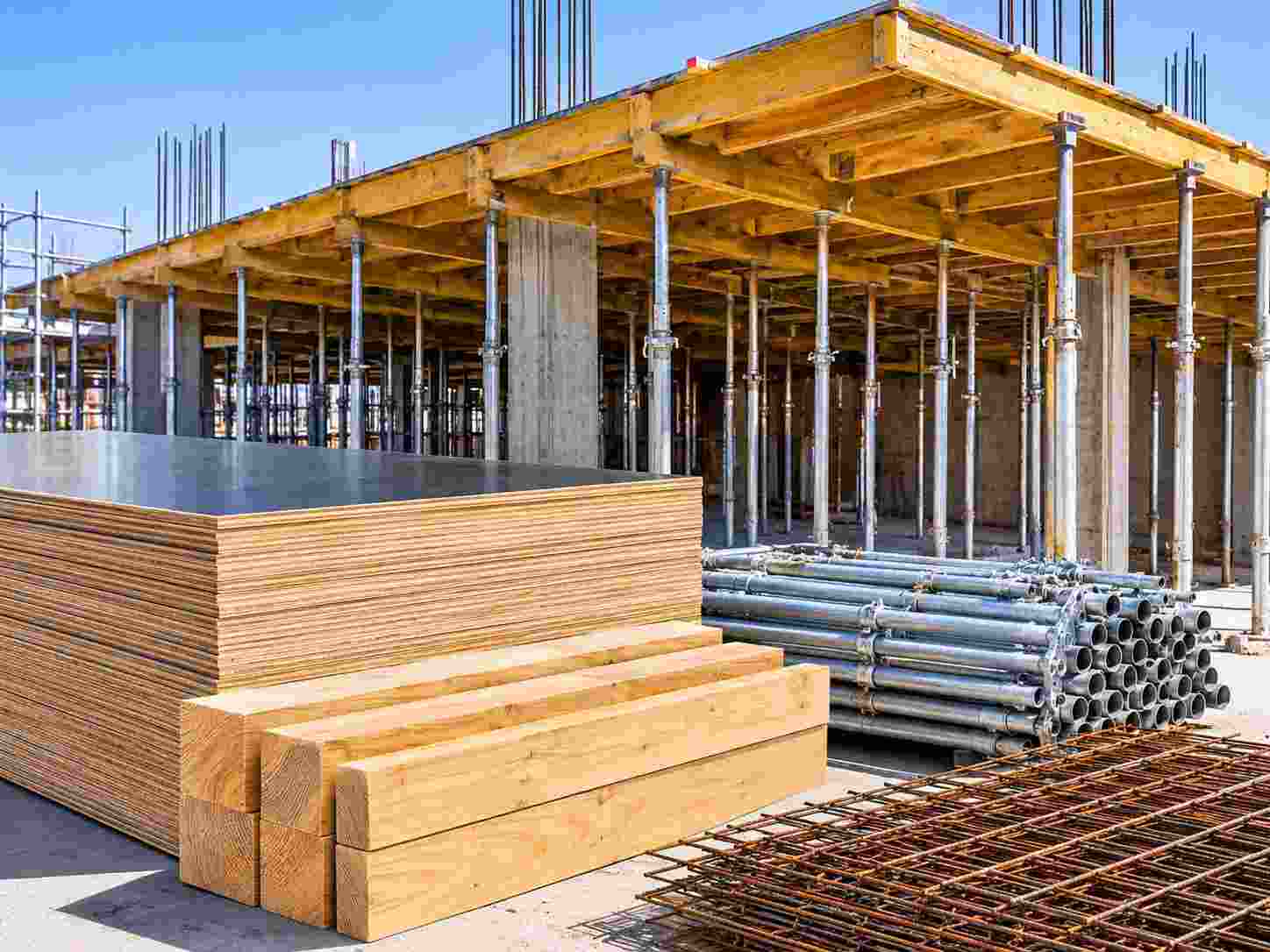
Most conventional formwork setups use the same core materials:
- Formply: the sheeting that touches the concrete
- Bearers: the main horizontal supports carrying the load
- Joists: the secondary members that sit on the bearers and support the formply
- Props: adjustable steel props that carry the load to the ground
- Fixings and accessories: nails, screws, form ties, release agent and edge forms
This post focuses on the three timber products builders order most: F17 formply, LVL bearers and LVL joists.
F17 Formply: What It Is and Why Builders Use It
F17 is a stress grade for structural plywood. Formply is made for formwork, with a smooth, durable face designed to give a cleaner concrete finish and handle repeated use.
Why builders choose it:
- Strong enough for slab and beam formwork
- Smooth face for a better concrete finish
- Reusable across multiple pours when cared for
- Easy to cut and fix on site
- Widely used and widely understood across the trade
Standard sheet size: 2400 x 1200 mm is the common format.
How to Choose the Right Formply
- Thickness: match to your joist spacing and the finish required. Thicker sheets allow wider joist spacing.
- Face quality: exposed concrete needs a better face than a concealed slab soffit.
- Edge sealing: sealed edges resist moisture and last longer.
- Compliance: ask for evidence the product meets the relevant structural plywood standard (AS/NZS 2269).
- Branding and grade marks: check for legible grade stamps on the sheets.
Formply Care Tips (Get More Pours Out of Every Sheet)
- Clean off concrete straight after stripping
- Apply release agent before each pour
- Seal cut edges
- Stack flat and keep covered
- Use fewer nail holes, and avoid nailing into the same spot repeatedly
LVL Bearers and Joists: Why LVL Beats Standard Timber
LVL (laminated veneer lumber) is made by bonding thin timber veneers together. The result is a straighter, stronger and more consistent member than sawn timber.
Benefits for formwork:
- Consistent strength: fewer weak spots like knots
- Straight and stable: less warping and twisting
- Longer spans: fewer props needed
- Predictable performance: easier to design and check
- Light for the strength: easier handling on site
LVL structural standard: AS/NZS 4357.
Bearers vs Joists: Quick Difference
Bearers | Joists | |
Role | Primary support | Secondary support |
Sits on | Props or primary frames | Bearers |
Supports | Joists | Formply |
Typical size | Deeper, heavier | Lighter, closer spaced |
Bearers carry the load down to the props. Joists carry the formply and pass the load into the bearers.
How to Choose LVL Sizes
Sizes and spacing depend on slab thickness, span, prop spacing and loads during the pour. Don’t guess.
- Slab thickness: thicker slabs mean heavier wet-concrete loads
- Prop spacing: closer props allow lighter members
- Pour method: pump and placement loads add pressure
- Engineer or formwork designer sign-off: required on larger or more complex jobs
For formwork design requirements, refer to AS 3610 and your engineer’s specifications.
6 Mistakes Builders Make When Buying Formwork Materials
- Ordering by price only. Cheap formply with poor face quality ruins the finish and has to be replaced after one or two pours.
- Under-ordering. Running short mid-pour means delays and rushed substitutes.
- Ignoring lead times. Peak periods stretch delivery windows. Order early.
- Mixing grades. Keep bearers, joists and formply consistent so your design assumptions hold.
- Skipping storage planning. Wet, stacked-on-the-ground timber is ruined before it’s used.
- Not asking for compliance proof. If a supplier can’t show grade and standard compliance, move on.
How Much Should You Order?
Work it out from the drawings:
- Formply: total slab and edge area, divided by sheet area (2.88 m² per 2400 x 1200 sheet), plus 10% to 15% for cuts and waste
- Joists: area divided by joist spacing, plus allowance for edges and openings
- Bearers: length of runs at your design spacing
- Props: per your formwork design
Send the plans to your supplier. A good one will help check quantities before you order.
What to Ask Your Formwork Supplier
- Are the F17 formply and LVL compliant with Australian standards?
- What sizes and lengths do you stock?
- Can you cut LVL to length?
- How fast can you deliver in Sydney?
- Can you deliver to tight or inner-city sites?
- Can you supply props, ties and accessories in the same order?
- Can you help check my quantities?
Delivery in Sydney: Plan It Properly
Formwork materials are bulky and heavy. Before ordering:
- Confirm truck access and unloading method
- Check council or permit requirements for street deliveries
- Schedule delivery when someone’s on site to receive it
- Have a dry, flat, covered area ready for storage
For more, read our guide on building materials delivery in Sydney.
Looking at Alternatives? Consider PVC Formwork
For walls, basements and retaining structures, permanent formwork can save time compared with traditional timber systems. See PVC formwork in Sydney: benefits and uses.
Frequently Asked Questions – Formwork Supplies in Sydney
F17 is a structural stress grade indicating the strength classification of plywood used in construction and formwork applications.
The common standard formply sheet size is 2400 x 1200 mm, suitable for many concrete formwork applications.
LVL is generally straighter, more consistent and stronger for its size than conventional sawn timber. This helps provide reliable support and performance across formwork spans.
Bearers are the primary horizontal supports that sit on props. Joists are placed on top of the bearers and support the formply sheets.
Formply reuse depends on its face quality, cleaning, sealing and handling. Proper maintenance and careful stripping can help extend its working life.
Larger or more complex formwork projects typically require an engineered design. Always check your project requirements and applicable standards, including AS 3610.
Contact Building Gear to confirm delivery availability, lead times and minimum order requirements for your Sydney project.
Get a Formwork Materials Quote in Sydney
Need formply, LVL or complete formwork supplies for your next pour? Send us your plans or material list and our team will help with a quote.
Get a Free Quote