When you’re working on a construction project in Sydney, choosing the right formwork can have a big impact on how smoothly the job progresses. Traditional timber and plywood formwork have been used for years, but PVC formwork is becoming an increasingly useful option for projects where speed, durability and consistent results matter.
But what exactly is PVC formwork, and is it right for your project?
In this guide, we’ll explain PVC formwork in simple terms, where it is used, its key benefits, and what Sydney builders should consider before choosing a formwork system.
What Is PVC Formwork?
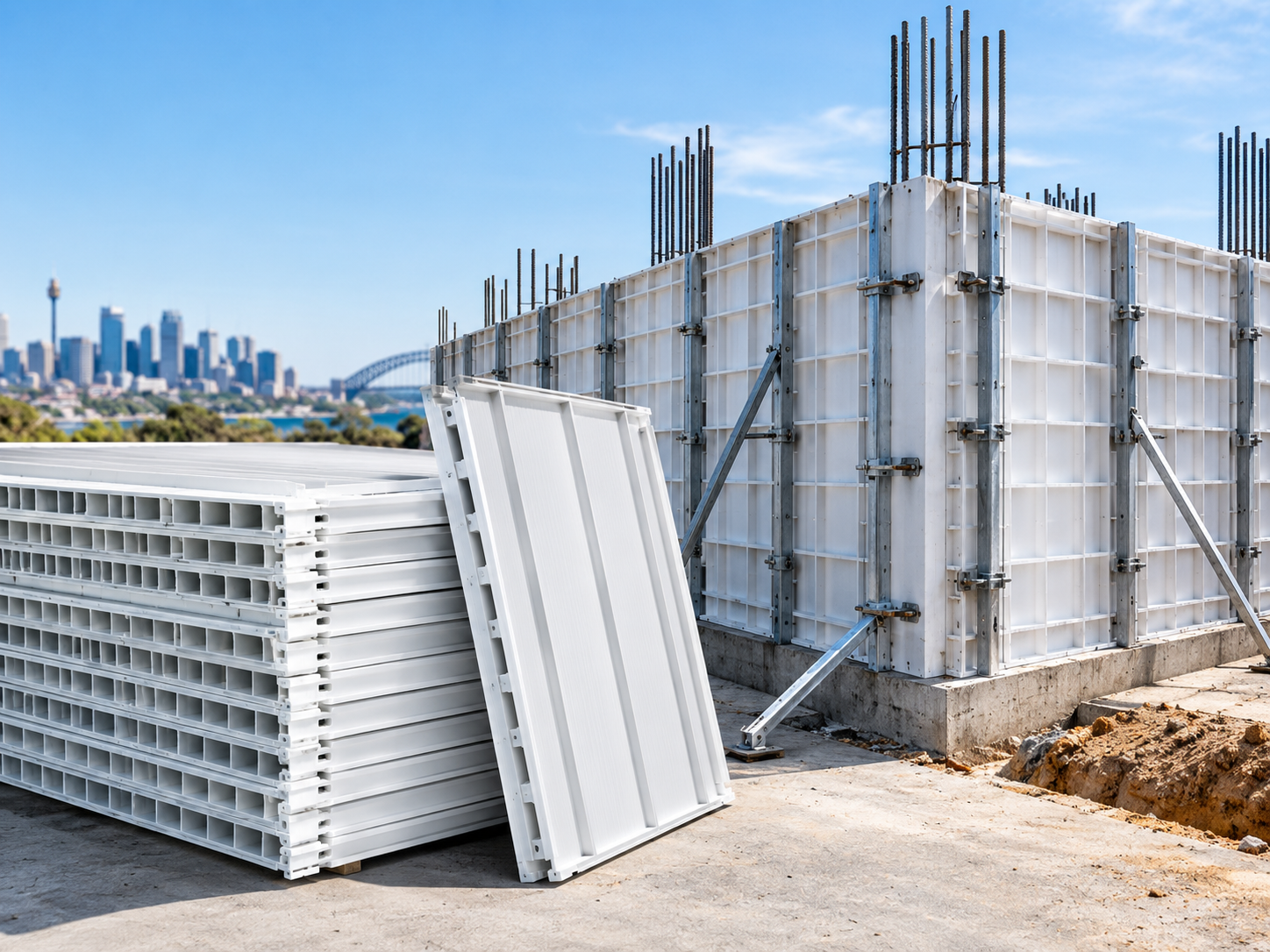
PVC formwork is a formwork system made using rigid PVC panels or components that are used to create the required shape for concrete.
Unlike temporary timber formwork that is removed after the concrete has cured, some PVC systems are designed as permanent formwork, meaning the formwork remains in place after the concrete has been poured.
Depending on the system, PVC formwork can be used to create:
- Concrete walls
- Columns
- Retaining walls
- Basement walls
- Structural cores
- Tanks
- Other reinforced concrete structures
The exact applications depend on the particular PVC formwork system and its engineering specifications.
How Does PVC Formwork Work?
The basic process is relatively straightforward.
- The PVC panels are positioned according to the project design.
- Reinforcement steel is installed where required.
- Concrete is poured into the formwork.
- The concrete cures inside the system.
- With permanent systems, the PVC remains in place as part of the completed construction.
This approach can reduce the amount of dismantling associated with traditional temporary formwork systems.
Benefits of PVC Formwork
1. Faster Construction
One of the biggest advantages of PVC formwork is the potential to speed up construction.Panels can be designed for efficient assembly, allowing construction teams to move through repetitive wall or structural work more quickly.For projects where labour and construction time are major considerations, this can be valuable.
2. Reduced Formwork Removal
With permanent PVC formwork systems, there is no need to remove the formwork after the concrete has cured.This can reduce the time and labour involved in stripping traditional formwork.
3. Consistent Results
PVC panels can provide a consistent form for concrete structures.When correctly installed, this can help achieve uniform dimensions and a cleaner, more predictable finish.
4. Resistant to Moisture
PVC does not absorb water in the same way as timber-based materials.This can make PVC formwork particularly useful in applications where moisture exposure is an important consideration.However, the actual performance depends on the specific product and its design.
5. Durable Formwork System
PVC is a durable material that can withstand demanding construction conditions when the correct system is selected and installed according to the manufacturer's requirements.
6. Less Material Handling
A well-designed formwork system can simplify construction by reducing the amount of temporary formwork material that needs to be moved, installed and removed on site.
Where Is PVC Formwork Used?
PVC formwork can be used across a range of construction applications.
Common examples include:
Residential Construction
PVC formwork can be used for structural walls and other concrete elements in residential projects.
Basements
Its resistance to moisture can make suitable PVC systems useful for basement construction.
Retaining Walls
PVC formwork can be used with reinforced concrete to create retaining structures where the system is appropriately designed for the application.
Commercial Buildings
Some commercial projects use permanent formwork systems for structural walls, cores and other concrete elements.
Water-Related Structures
Depending on the product specifications, PVC formwork systems may also be suitable for certain tanks and structures where moisture resistance is important.
PVC Formwork vs Traditional Formwork
So, how does PVC formwork compare with traditional timber or plywood formwork?
Feature | PVC Formwork | Traditional Formwork |
Material | PVC-based system | Commonly timber or plywood |
Removal | Permanent systems remain in place | Usually removed after curing |
Moisture resistance | Generally high | Timber-based materials require moisture management |
Installation | System-specific | Often requires more site fabrication |
Reusability | Depends on system | Depends on formwork type |
Construction speed | Can be faster for suitable applications | Depends on project and system |
Best use | Specific permanent formwork applications | Wide range of temporary formwork applications |
There isn’t one solution that is best for every project.
The right choice depends on the structure, engineering requirements, site conditions, construction method and project budget.
Is PVC Formwork Suitable for Sydney Construction?
PVC formwork can be a practical option for many Sydney construction projects, provided the selected system is suitable for the application.
Sydney construction sites can experience changing weather conditions, including rain and high moisture exposure. Using a formwork material that is not prone to water absorption like timber can be an advantage in some applications.
However, weather resistance should not be the only reason to select PVC formwork.
You should also consider:
- Structural requirements
- Building design
- Concrete requirements
- Reinforcement requirements
- Site conditions
- Installation method
- Engineering certification
- Manufacturer specifications