
Search “building materials suppliers Sydney” and you’ll get pages of results — big-box hardware chains, specialist panel and flooring suppliers, timber yards, and smaller trade-focused operators. They all claim to be reliable, competitive and easy to deal with. On paper, most of them look the same.
The real difference only shows up once you’re mid-project: when a delivery is late, when accessories are missing from a supply order, or when nobody picks up the phone the week before a pour. Choosing the right supplier isn’t about finding the biggest catalogue — it’s about finding one that won’t become the reason your build falls behind schedule.
Here’s what actually separates a good building materials supplier from a risky one, and how to evaluate your options properly before you commit to a project.
Why the "Right" Supplier Matters More Than the Cheapest One
It’s tempting to choose a supplier purely on unit price, especially on a tight budget. But the cheapest quote on paper isn’t always the cheapest outcome once you factor in:
- Delays caused by stock shortages or missed accessories
- Rework or downtime from incorrect quantities or specifications
- Extra freight costs from suppliers who can’t coordinate delivery properly
- Site disputes caused by materials arriving without the right lift or unloading equipment
A supplier that’s slightly more expensive but consistently accurate, on time, and easy to communicate with will almost always save money across the life of a project — because on a construction site, time is the most expensive material of all.
What to Look For in a Building Materials Supplier
1. Product Range That Actually Matches Your Project
Some suppliers specialise in one category — timber, or flooring, or wall systems. Others assist across a broader range of building materials, which can simplify pricing and coordination if your project needs multiple product types. Before choosing, check whether the supplier can genuinely assist with everything your build needs, rather than sending you elsewhere for half the order.
2. Accurate, Detailed Quoting
A trustworthy supplier asks the right questions before quoting — project address, quantities, specifications, delivery access, site conditions — rather than firing back a generic price. Vague quotes are one of the biggest causes of on-site disputes later, when “supply only” turns out not to include the fixings, adhesive or accessories the job actually needed.
3. Realistic Lead Times
Sydney’s building material lead times shift constantly depending on demand, product type and season. A supplier who gives you a clear, honest lead time — even if it’s longer than you hoped — is more useful than one who tells you what you want to hear and then delays the order.
4. Delivery and Site Access Coordination
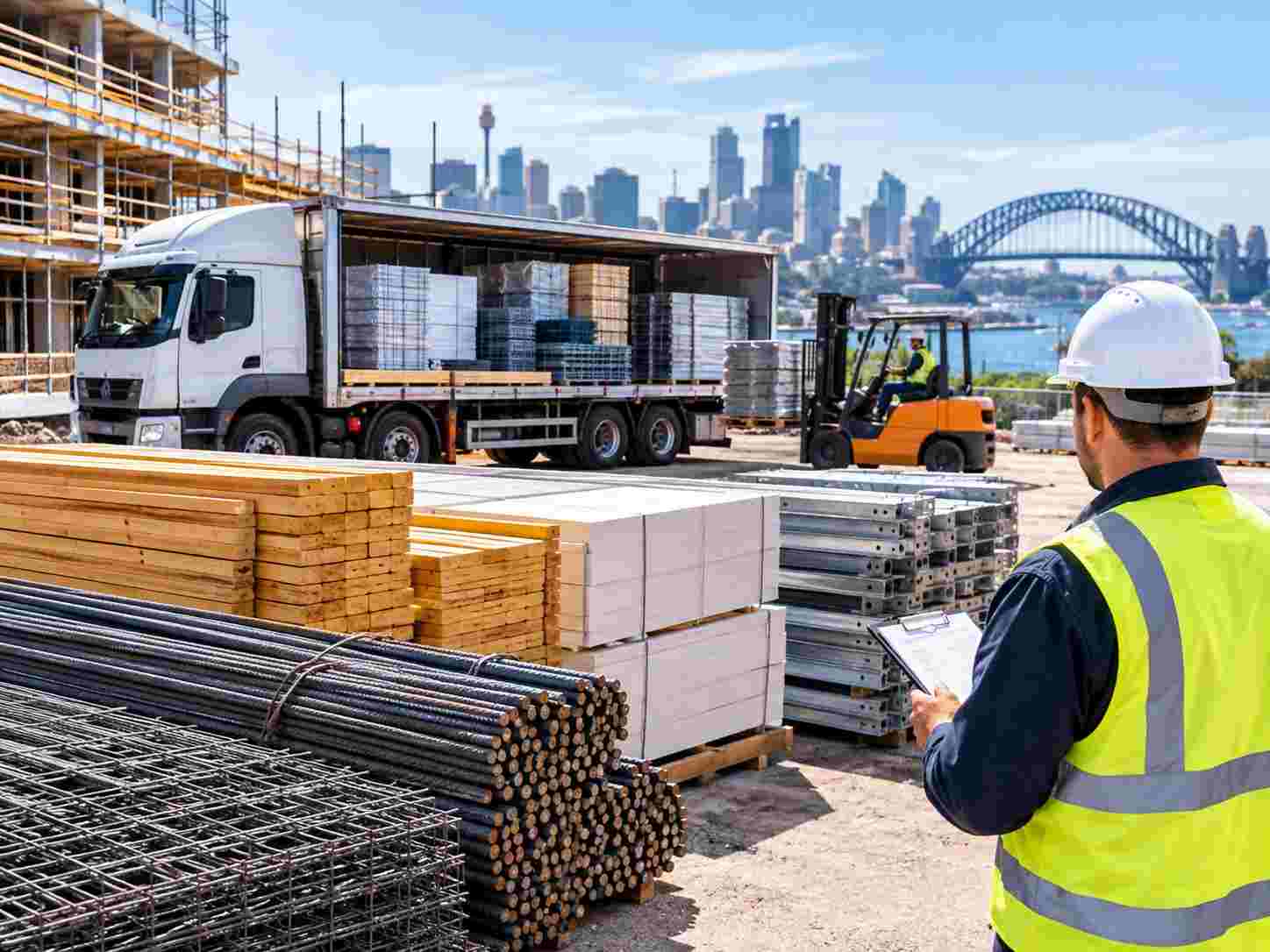
Sydney sites vary enormously: tight inner-city terraces, sloping blocks, strata driveways, multi-storey developments. A supplier who asks about site access, unloading requirements (forklift, Hiab, crane) and upper-floor lifts before delivery day is one who understands construction logistics — not just retail sales.
5. Communication and Responsiveness
During a live build, you need answers fast — not a ticket number and a three-day wait. Suppliers who are easy to reach by phone or email, and who follow up proactively on order status, reduce the chances of a small issue turning into a site delay.
6. Flexibility Between Supply-Only and Supply-and-Install
Not every project needs the same level of service. Some builders already have their own installers and just need reliable product supply; others want a more complete solution. A supplier who can flex between supply-only and supply-and-install — depending on the project — gives you more control over cost and scheduling.
Supply-Only vs. Supply-and-Install: Which Suits Your Project?
Supply-Only | Supply-and-Install | |
Best for | Builders with their own installers or subcontractors | Homeowners or teams wanting one less thing to manage |
Cost structure | Pay for materials + freight only | Pay for materials + coordinated install |
Control | You ma nage scheduling and trades | Supplier helps coordinate the install timeline |
Risk if under-specified | You catch missing accessories before ordering | Supplier is more likely to flag gaps during quoting |
Good fit for | Volume builders, developers, repeat projects | One-off renovations, first-time projects, smaller teams |
Neither option is “better” — it depends on whether you already have trusted installers lined up, or whether you’d rather one supplier manage more of the process.
Red Flags to Watch For
- No breakdown in the quote — just a total price, with quantities and accessories left unclear
- No questions about site access — a supplier who doesn’t ask about delivery method or access is guessing, not planning
- Vague or shifting lead times — especially estimates that get longer after you’ve committed
- No named point of contact once the order is placed
If a supplier can’t answer these upfront, that’s usually a preview of how the rest of the project will go.
Questions Worth Asking That Most Builders Forget
Beyond the obvious “how much” and “how long,” a few less-common questions tend to reveal how a supplier actually operates:
- “What happens if my site access changes after I order?” — A good supplier will explain their process for adjusting a Hiab or crane booking; a weak one won’t have an answer.
- “Can I get accessories and main materials priced as one package, or will they be quoted separately?” — Separate quoting is often where accessory gaps slip through.
- “Who do I contact directly if something’s wrong with the order — not a general inbox?” — This tells you whether you’re a project to them, or a transaction.
- “Do you handle upper-floor or restricted-access deliveries regularly, or is that an exception for you?” — Sydney’s density means this comes up more than suppliers admit.
Asking these before you order costs nothing — chasing the answers after a delivery has gone wrong costs days.
A Simple Checklist Before You Choose a Supplier
- Can they supply everything your project needs, or only part of it?
- Do they ask for project details before quoting, or just give a flat price?
- Is the lead time clearly stated and realistic?
- Have they asked about site access and delivery requirements?
- Can they offer both supply-only and supply-and-install options?
- Is there a direct contact for order updates and issues?
Where Building Gear Fits In
Building Gear works with builders, contractors and developers across Sydney to assist with the supply of a range of building materials — including flooring, Hebel AAC wall panels and related accessories — with supply-only or supply-and-install options depending on the project.
We ask for the details that actually affect a quote — project address, specifications, quantities, delivery access — before pricing anything, and we assist with coordinating delivery requirements like Hiab or crane unloading where needed. If you’re comparing suppliers for an upcoming project, feel free to send through your plans or requirements and we’ll assist with a competitive, detailed quote.
📧 sales@buildinggear.com.au 📞 0494 393 682 🌐 www.buildinggear.com.au
Frequently Asked Questions
What's the most important factor when choosing a building materials supplier in Sydney?
Reliability and accurate quoting tend to matter more than the lowest unit price — a cheap quote that leads to delays or missing accessories often costs more overall.
Should I choose a supplier who offers both supply-only and supply-and-install?
depends on your project. If you already have your own installer, supply-only can be more cost-effective. If you want less to manage on site, a supplier offering both gives you flexibility to choose per project.
Why do delivery and site access matter when choosing a supplier?
Sydney sites vary widely in access — from tight inner-city streets to sloping blocks and strata driveways. A supplier who plans for this in advance avoids delivery-day delays and additional costs.
How do I avoid missing accessories in a materials order?
Choose a supplier who prices accessories, fixings and delivery together with the main product — not just the headline item — and confirms full specifications before quoting.